Install and use packages with CMake in Visual Studio
This tutorial shows you how to create a C++ "Hello World" program that uses the fmt library with CMake, kmpkg and Visual Studio. You'll install dependencies, configure, build, and run a simple application.
Prerequisites
- Visual Studio with C++ development workload and CMake component
- Git
1 - Set up kmpkg
-
Clone the repository
The first step is to clone the kmpkg repository from GitHub. The repository contains scripts to acquire the kmpkg executable and a registry of curated open-source libraries maintained by the kmpkg community. To do this, run:
git clone https://github.com/kumose/kmpkg.gitThe kmpkg curated registry is a set of over 2,000 open-source libraries. These libraries have been validated by kmpkg's continuous integration pipelines to work together. While the kmpkg repository does not contain the source code for these libraries, it holds recipes and metadata to build and install them in your system.
-
Run the bootstrap script
Now that you have cloned the kmpkg repository, navigate to the
kmpkgdirectory and execute the bootstrap script:
- cmd
- powershell
- bash
cd kmpkg && bootstrap-kmpkg.bat
cd kmpkg; .\bootstrap-kmpkg.bat
cd kmpkg && ./bootstrap-kmpkg.sh
The bootstrap script performs prerequisite checks and downloads the kmpkg executable.
That's it! kmpkg is set up and ready to use.
2 - Set up the Visual Studio project
-
Create the Visual Studio project
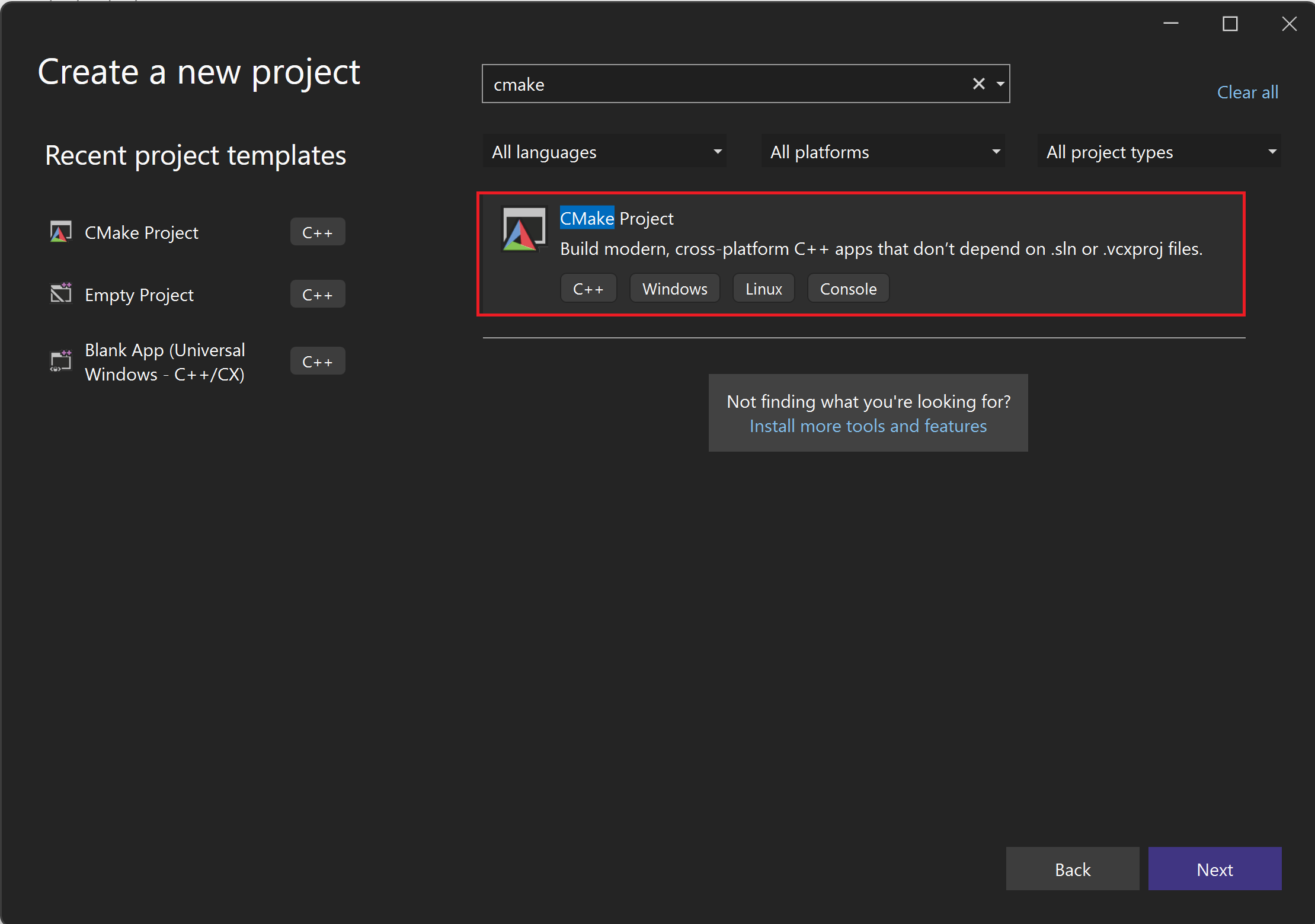
- Create a new project in Visual Studio using the "CMake Project" template
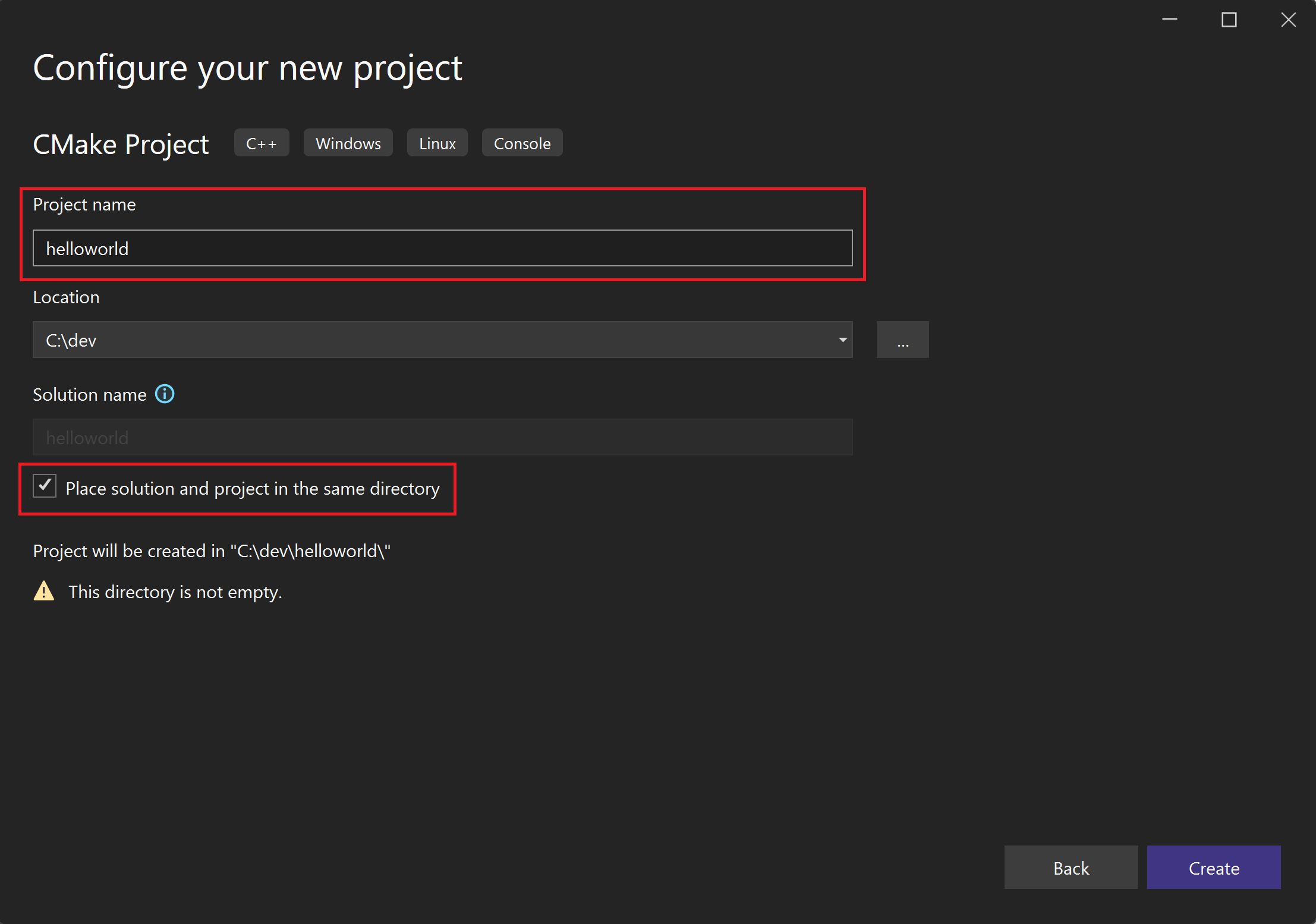
- Name your project "helloworld"
- Check the box for "Place solution and project in the same directory."
- Click the "Create" button
- Configure the
KMPKG_ROOTenvironment variable.
Setting environment variables in this manner only affects the current terminal session. To make these changes permanent across all sessions, set them through the Windows System Environment Variables panel.
- powershell
- cmd
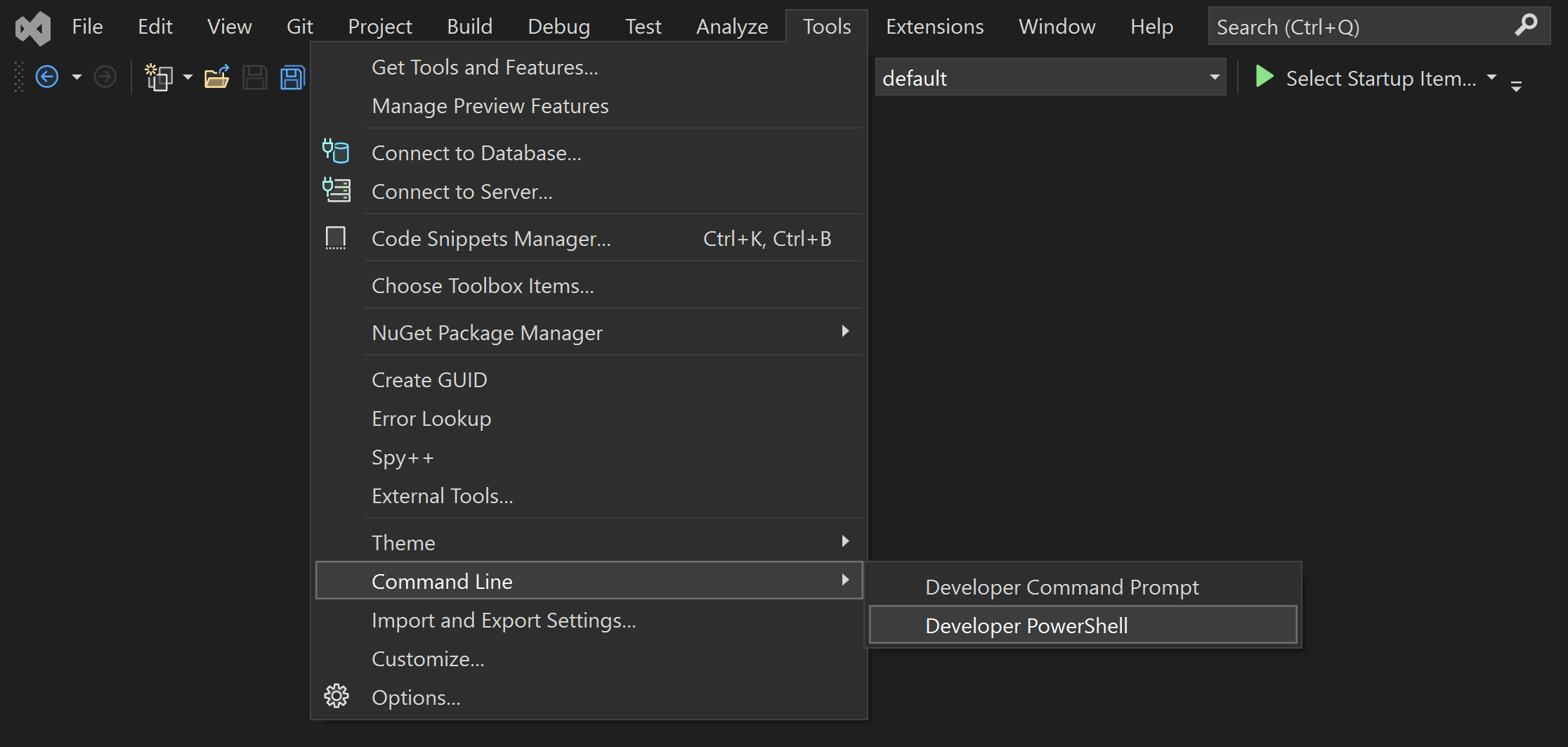
Open the built-in Developer PowerShell window in Visual Studio.
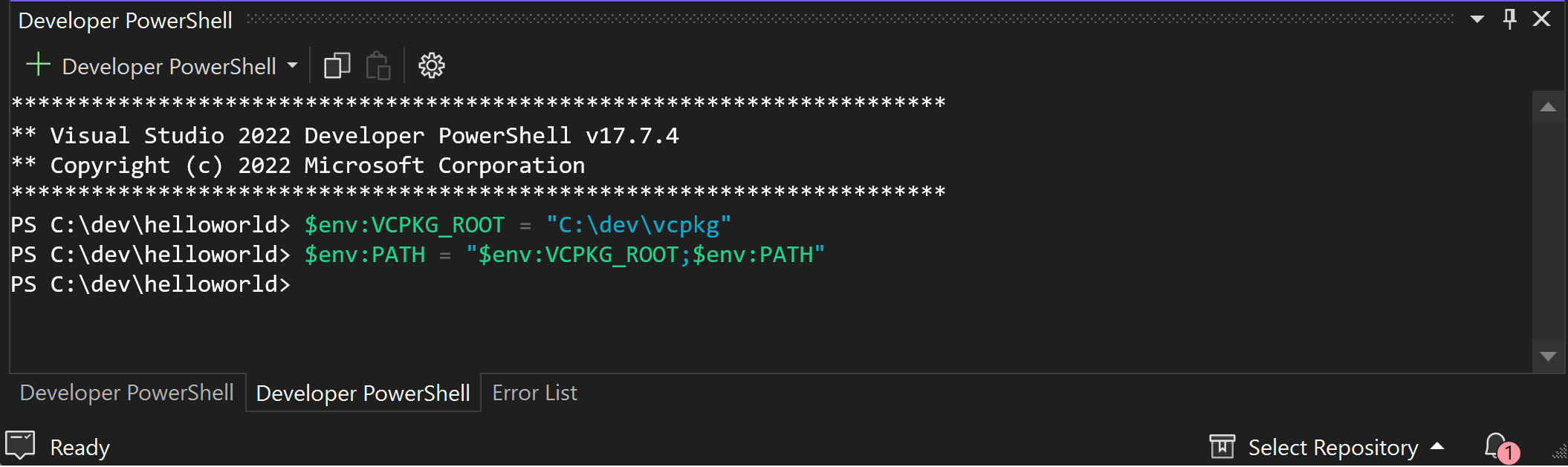
Run the following commands:
$env:KMPKG_ROOT="C:\path\to\kmpkg"
$env:PATH="$env:KMPKG_ROOT;$env:PATH"
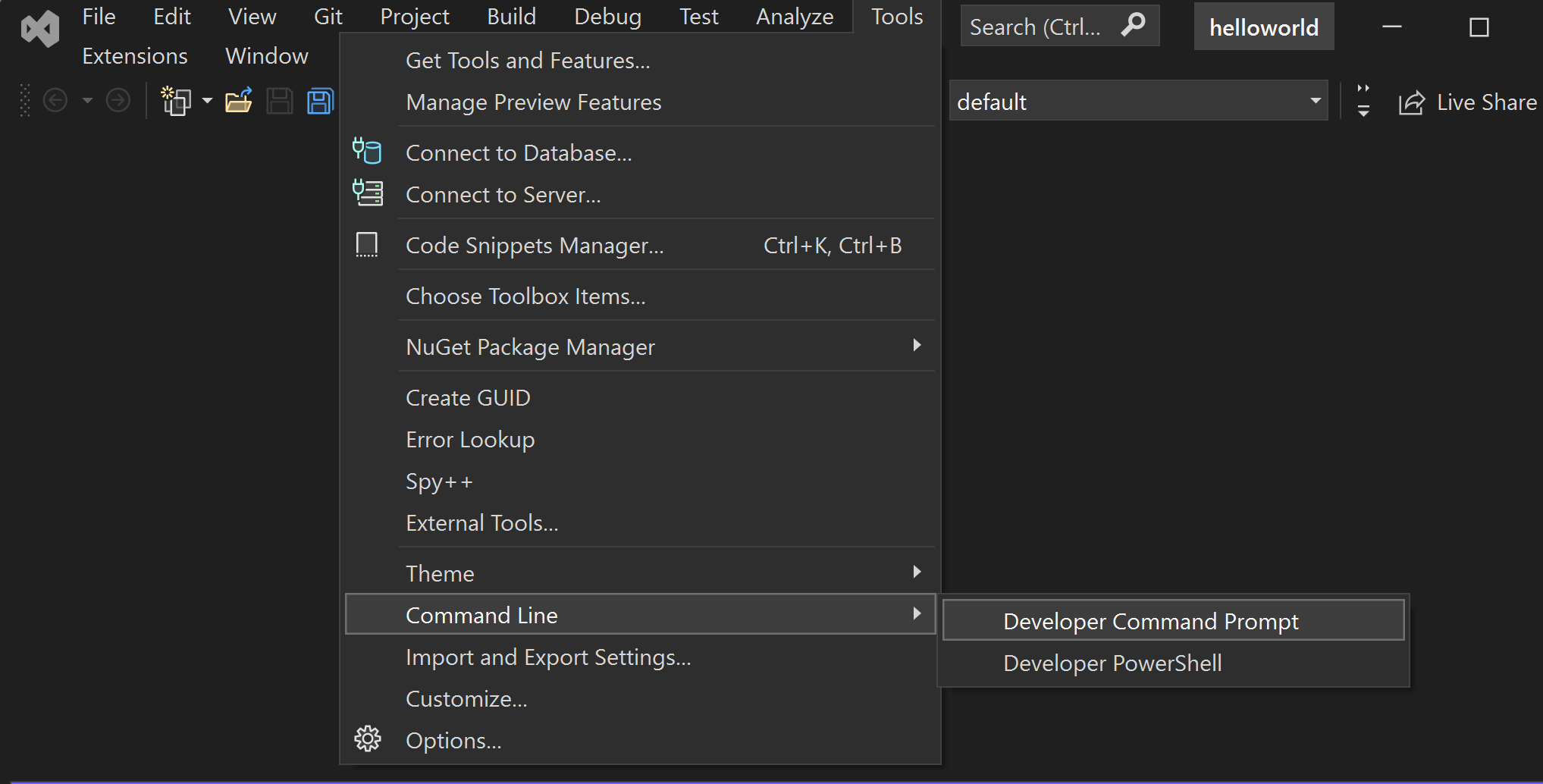
Open the Developer command prompt in Visual Studio.
Run the following commands:
set "KMPKG_ROOT=C:\path\to\kmpkg"
set PATH=%KMPKG_ROOT%;%PATH%
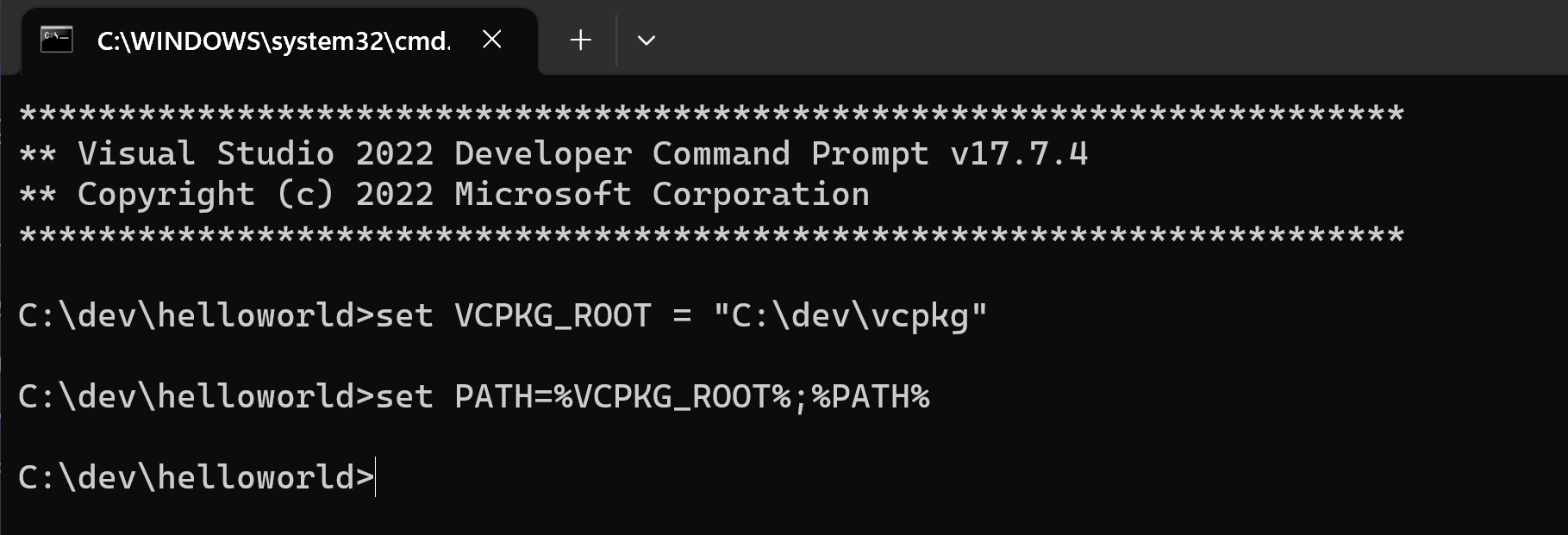
Setting KMPKG_ROOT helps Visual Studio locate your kmpkg instance.
Adding it to PATH ensures you can run kmpkg commands directly from the shell.
-
Generate a manifest file and add dependencies.
Run the following command to create a kmpkg manifest file (
kmpkg.json):kmpkg new --applicationThe
kmpkg newcommand adds akmpkg.jsonfile and akmpkg-configuration.jsonfile in the project's directory.Add the
fmtpackage as a dependency:kmpkg add port fmtYour
kmpkg.jsonshould now contain:{
"dependencies": [
"fmt"
]
}This is your manifest file. kmpkg reads the manifest file to learn what dependencies to install and integrates with CMake to provide the dependencies required by your project.
The generated
kmpkg-configuration.jsonfile introduces a baseline that places minimum version constraints on the project's dependencies. Modifying this file is beyond the scope of this tutorial. While not applicable in this tutorial, it's a good practice to keep thekmpkg-configuration.jsonfile under source control to ensure version consistency across different development environments.
3 - Set up the project files
-
Modify the
helloworld.cppfile.Replace the content of
helloworld.cppwith the following code:
#include <fmt/core.h>

int main()
{
    fmt::print("Hello World!\n");
    return 0;
}
This source file includes the <fmt/core.h> header which is part of the fmt library. The main() function calls fmt::print() to output the "Hello World!" message to the console.
-
Configure the
CMakePresets.jsonfile.CMake can automatically link libraries installed by kmpkg when
CMAKE_TOOLCHAIN_FILEis set to use kmpkg's custom toolchain. This can be acomplished using CMake presets files.Modify
CMakePresets.jsonto match the content below:
    {
  "version": 2,
  "configurePresets": [
    {
      "name": "kmpkg",
      "generator": "Ninja",
      "binaryDir": "${sourceDir}/build",
      "cacheVariables": {
        "CMAKE_TOOLCHAIN_FILE": "$env{KMPKG_ROOT}/scripts/buildsystems/kmpkg.cmake"
      }
    }
  ]
}
Create CMakeUserPresets.json with the following content:
{
  "version": 2,
  "configurePresets": [
    {
      "name": "default",
      "inherits": "kmpkg",
      "environment": {
        "KMPKG_ROOT": "<path to kmpkg>"
      }
    }
  ]
}
The CMakePresets.json file contains a single preset named "kmpkg", which
sets the CMAKE_TOOLCHAIN_FILE variable. The CMakeUserPresets.json file
sets the KMPKG_ROOT environment variable to point to the absolute path
containing your local installation of kmpkg. It is recommended to not check
CMakeUserPresets.json into version control systems.
-
Edit the
CMakeLists.txtfile.Replace the contents of the
CMakeLists.txtfile with the following code:
cmake_minimum_required(VERSION 3.10)

project(HelloWorld)

find_package(fmt CONFIG REQUIRED)

add_executable(HelloWorld helloworld.cpp)

target_link_libraries(HelloWorld PRIVATE fmt::fmt)
Now, let's break down what each line in the CMakeLists.txt file does:
cmake_minimum_required(VERSION 3.10): Specifies that the minimum version of CMake required to build the project is 3.10. If the version of CMake installed on your system is lower than this, the build fails.project(HelloWorld): Sets the name of the project to "HelloWorld."find_package(fmt CONFIG REQUIRED): Looks for thefmtlibrary using its CMake configuration file. TheREQUIREDkeyword ensures that an error is generated if the package is not found.add_executable(HelloWorld helloworld.cpp): Adds an executable target named "HelloWorld," built from the source filehelloworld.cpp.target_link_libraries(HelloWorld PRIVATE fmt::fmt): Specifies that theHelloWorldexecutable should link against thefmtlibrary. ThePRIVATEkeyword indicates thatfmtis only needed for buildingHelloWorldand should not propagate to other dependent projects.
4 - Build and run the project
-
Build the project.
Build the project using the
Build > Build Alloption from the top menu. -
Run the application.
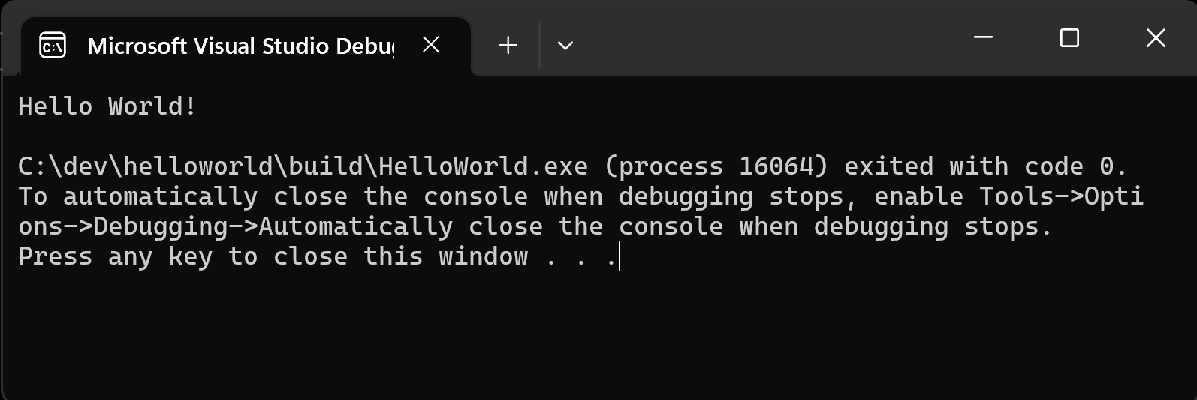
Finally, run the executable:

You should see the output:
Next steps
To learn more about kmpkg.json, see our reference documentation: